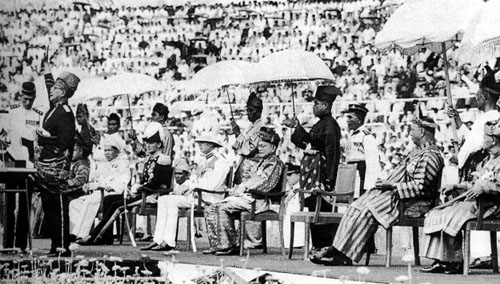
– from ‘The Origins and Evolution of Ethnocracy in Malaysia’
This article is the third part to Dr Geoff Wade’s writing on ‘Ethnocracy’ – ARI Working Paper No.111 – and has been condensed by CPI.
PART 3
The British had failed to include Chinese aspirations in the 1948 Constitutional arrangements while instead choosing to strike hard at the Chinese movements.
By Dr Geoff Wade
The Malayan Union (1946) and the Federation of Malaya
[The idea of social equality under the Malayan Union proposals among the various ethnic groups was not to have a long life-span.]
The Malayan Union was to last but two years and during this period it was subject to a remarkable turnaround on the part of the British. Through 1946 and 1947, there was a 180-degree turn from a proposed polity with equal citizenship to one where Malays were dominant, privileged and power-brokers.
However, a major element was the creation of a Malay political party during this period – the United Malays National Organisation (Umno), which was led by the Johor political elite and headed by Onn Jaafar. A key element of its creation was the intent to oppose the Malayan Union arrangements.
By July 1946, the British responded to Malay concerns about the Malayan Union by creating a 12-man ‘Political Working Committee’ comprising six government representatives, four royal delegates, and two Umno representatives to consider and recommend a new constitutional framework for the Malayan Union.
The question remains as to why it was decided that only Malay representatives were to negotiate the future of Malaya with the British.
A key element of the [new] proposals was that relating to citizenship. Federal citizenship would be acquired by:
1. Any subject of the ruler of any state. This included all Malays and excluded all non-Malays;
2. British subjects born locally;
3. Children of fathers who were federal citizens.
It was obvious that all previous proposals of an egalitarian society had been scrapped, the feudal rulers were to be maintained to bolster Malay claims to power, the Legislative Council was to be powerfully weighted towards the Malays and all other communities were to be essentially sidelined. The Constitution was thus a blueprint for Malay ethnocracy.
Reactions to the Federation of Malaya Proposals 1946-1948
On the same day as the new Constitutional proposals were released – 14 December 1946 – a Council of Joint Action was established in Singapore to oppose the proposed Constitution. The initial meeting was attended by 75 delegates, including representatives of the Malay Nationalist Party,1 the Malayan Democratic Union and various trade unions. Tan Cheng Lock was elected as chairman.
The Council adopted three principles to guide their opposition:
1. A united Malaya inclusive of Singapore;
2. Responsible self-government through a fully elected Central legislature;
3. Equal citizenship rights for all who make Malaya their home.
The first principle violated everything the British were working toward with the new proposals. By including Singapore in the new Malayan polity, the ethnic proportion of Malays would fall below that of Chinese, which would nullify the alleged validity of the proposals.2
The year 1947 was to prove a year of political wrangling, and one where Umno was to attempt to consolidate the foothold which the Colonial Office had provided them. In January of that year, at the opening of the Umno general assembly in Kedah, the Sultan of Kedah urged that “the Malay rulers and Umno must join hands in carrying out the constitutional proposals for the benefit of the Malays,??? while Dato Onn emphasized that the peninsula was the home of the Malays and “we shall preserve it as the home of the Malays.??? 3
Meanwhile, both Malayan Left and Right combined in opposition to the proposals.
On February 22, 1947, a new coalition of Malay political and cultural organisations called Pusat Tenaga Rakyat (Putera) was organised to act as a counter weight to Umno. A total of 29 organisations including PKMM, Barisan Tani Se-Malaya (Peasant’s Union or Batas) and Hizbul Muslimin were part of this coalition.
Despite the widespread opposition to the proposals from members of all ethnic communities of both Left and Right, the Cheeseman Consultative Committee report was completed and published by 19 April 1947 – again a remarkably swift period of ‘consultation’ on such a key issue, underlining that the Colonial Office did not want to see their plans upset.
Within four days, on 23-24 April 1947, Malcolm MacDonald met in Kuala Lumpur the members of the Governor-General’s Advisory Committee, comprising only the Malay Rulers, representatives of Umno and government officials, in order to discuss the Cheeseman report.
The Colonial Office bias
On 24 July 1947 the Summary of the Revised Constitutional Proposals was published. This included a provision for a Malay majority in the proposed Malayan legislature, a provision not endorsed by the Cheeseman Committee which preferred an equal balance between Malay and non-Malay interests. Again we see the Colonial Office and Malcolm MacDonald joining with Dato Onn in laying down the basis for Malay ethnocracy in the new Malaya.
These proposals were then submitted to the British Government.4 The speed with which this was done and the fact that no Malayans others than Malays were engaged in the deliberations shows that the Colonial Office would brook no opposition to its policies.
As noted, key to Malay aspirations to power and concerns by the other communities were the citizenship provisions of the proposed Federal Constitution. It provided for Federal citizenship for:
- Any subject, wherever born, of His Highness the Ruler of any State;
- Any British subject born at any time in the settlements and has resided there for 15 years;
- Any British subject born in the territories of the federation and has resided there for 15 years;
- “Any person born at any time in any of the territories now to be comprised in the Federation, who habitually speaks the Malay language and conforms to Malay custom.???
The first and fourth categories included every ‘Malay’5 person in the peninsula, regardless of length of residence there, while the other provisions imposed residential requirements on persons of other communities. Again we see a concerted effort to exclude non-Malay persons from the polity and further efforts toward Malay ethnocracy.
The Colonial Office validated this as follows: “The present scheme is designed to include in a common citizenship all those, whether Malays or non-Malays, who can fairly be regarded as having Malaya for their true home. The Malays, however, are peculiarly the people of the country. They have no other homeland, no other loyalty. They thus have a special and justifiable interest in immigration policy, which it would be inequitable to refuse them.??? 6
The refusal to acknowledge that the ‘Malays’ had migrated to the peninsula from many other places in the archipelago was conveniently ignored in this disingenuous effort at validating Malay supremacy.
The claim that “the Malays form an absolute majority among those who regard Malaya as their permanent home and the sole object of their loyalty??? was neither validated nor supported, but it was an effective hook on which to hang British Colonial Office policy.
‘Sons of the soil’
Over the following months, the Governor General Malcolm MacDonald made repeated radio broadcasts stressing the bases for the new Constitution. On 5 October 1947, MacDonald broadcast as follows:
“To begin with, let this be remembered. The negotiations leading up to the Constitution ended a period of sharp political unrest and agitation which stirred to their depths the feelings of the entire Malay population. Eighteen months ago a peaceful and orderly, but unanimous and passionate Malay opposition to the Malayan Union cast a dark shadow across the once sunlit and placid political scene in Malaya. Virtually the whole people of the majority race in the country had lost confidence in the Government.??? 7
Again in January 1948, he told listeners that “Malay Kingdoms ruled by Malay princes date back many hundreds of years. They are the truest sons and daughters of the Malayan soil.??? 8
Hartal
However, the British seemed quite content to ignore the other communities who were actively expressing their loss of confidence in the government, and had been in the peninsula in many cases far longer than recent ‘Malay’ immigrants from Sumatra, Java, the Middle East, and Sulawesi.
Hartals9 were held in Malacca, Perak, and in Singapore throughout October. Shops were closed, plantation work ceased and commerce was absent during these days of protest.
The Malaya Tribune in an editorial on 24 January set down the overall objections to the procedures. “For reasons best known to themselves, the British Government has seen fit to completely ignore Chinese representations on the constitutional issue. The original proposals for a broader based legislature and the creation of a national status came from Great Britain, only for the last named to be withdrawn immediately on protests from the right-wing Malays whose boycott immediately brought the British Government to heel and all conduct of affairs since has been at the virtual dictation of the Malays….. the facts considered, it is hardly surprising that Chinese opinion is not prepared to see its leaders enter into the farce of serving upon the Malay-dominated Council and thus giving the appearance of seriously accepting the constitution as a reasonable stepping-stone towards political advancement.??? 10
But the plans of the Colonial Office would brook no delay and on 21 January 1948, state and Federation Treaties were signed by Malayan Union Governor Sir Edward Gent and eight of the Malay Rulers. On 1 February 1948, a Malay-dominated Federation of Malaya was initiated.
The 1948-1957 Period
In the middle of 1948, the Malayan Communist Party launched armed rebellion against the new state and the British state which controlled it. The degree to which British failure to include Chinese aspirations in the 1948 Constitutional arrangements precipitated the rebellion or encouraged the assistance it was to receive from the Chinese communities and the Left from all communities remains an issue for further study.
But it also provided a further avenue by which Umno could dominate the political firmament of the Federation and further exclude Chinese participation. The Colonial Office political report for November 1948 noted: “The Emergency has given the Malays an opportunity to improve their political position which they have not been slow to take. They point to the leading part which the Malay community is taking in the fight against terrorism, through the Malay regiment, the regular police and the special and auxiliary police. They contrast this with the behaviour of the Chinese.??? 11
At the same time, an anti-Chinese attitude became manifest among many of the British administrators.
A letter from Gimson, the Governor of Singapore to J.O. Higham on 15 October 1948 included a report by an unnamed person relating to revision of the Register of Electors. The report included the following: “I am convinced the attitude of 90 percent of the Chinese is this … In one respect, they are all agreed whether they be KMT or Communist, they are anti-British.???
The report, which Gimson chose to circulate, noted that the Government had to strike immediately and strike hard at all Chinese movements.
Given how the British government had treated the non-Malays in Malaya since 1946, such Chinese sentiments if they existed would have been fully comprehensible. However, this demonization of the entirety of the Malayan Chinese population validated, in the eyes of many, their exclusion from the Malayan political process. It was further endorsement and strengthening of the burgeoning Malay ethnocracy.
[In 1952, Onn Jaafar was replaced as head of Umno by Tunku Abdul Rahman. The first federal elections were held in July 1955 and the Alliance won 51 of the 52 seats available, and thus was able to form the first Malayan government, with Tunku Abdul Rahman as Chief Minister.]12
A commission was established under Lord William Reid to devise a constitution for the future Federation of Malaya. The Reid Commission met on over 100 occasions in 1956 and submitted its draft Constitution to a Working Committee in February 1957. This Working Committee consisted of four representatives from the Malay rulers, another four from the Alliance government, the British High Commissioner, the Chief Secretary, and the Attorney General, ensuring that it was essentially the interests of the Malays which were being represented.
The Constitution took effect on 15 August and on 31 August the Federation of Malaya became an independent country.
1957-1969 – Ethnocracy Consolidated
Under the new Federation of Malaya, Umno became increasingly assertive in promoting Malay dominance, an assertiveness not matched by MCA president Tan Cheng Lock in promoting the interests of his constituency. [Read pdf for full text]
Creation of Malaysia (1963)
The Tunku eventually advised that he was amenable to the new arrangements if, in addition to Malaya and Singapore, the new state definitely included Sabah, Sarawak and Brunei.
The aim was to ensure that the Chinese did not constitute a majority in Malaysia. It was in the negotiations leading up to this new state that a new Constitution was enacted, in which the Malay special rights were also made available to the “natives??? of Sabah and Sarawak, and on 31 August 1963, Malaysia (excluding Brunei) came into being.
With a new mandate in a new state, an increased ‘Bumiputra’ population, British support, broad anti-Communist sentiments and the Chinese community divided between Left and Right, the Tunku began further reforms in pursuing a Malay-dominated state.
Pushed by Tun Abdul Razak and Dr Ismail, the Tunku approved the creation or expansion of Malay-targeted institutions – Majlis Amanah Rakyat (Mara), the Federal Agricultural Marketing Authority (Fama), the Rubber Industry Smallholders Development Authority (Risda), and Bank Bumiputra.
Singapore was ousted from Malaysia on 9 August 1965. The departure of Singapore and its largely Chinese population from Malaysia allowed Umno to further consolidate the ethnocracy which now clearly marked federal and state politics.
Within the Alliance, the MCA was increasingly playing second-fiddle to Umno.
May 13
A National Operations Council (NOC, which comprised 7 Malays, one Chinese and one Indian), led by Tun Abdul Razak took over Government [after May 13]. An obscene interpretation of the violence of 1969 that has persistently been used as one of the validations of the New Economic Policy was that it was that the violence was due to economic inequalities.
It was during this period of ongoing unrest that little-known Umno backbencher Mahathir bin Mohamad – who had lost his Parliamentary seat in the election – publicly criticized the Tunku for having given “the Chinese what they demand…you have given them too much face. The responsibility for the deaths of this people, Muslims and infidels, must be shouldered by [you].”
1970 Onwards – The New Economic Policy
It was in 1970 that Tun Razak, head of the NOC, succeeded the Tunku as prime minister, and immediately began asserting even greater Malay dominance in the Alliance. The only post in his Cabinet held by a non-Malay was that of the MCA president Tan Siew Sin, who was appointed as Finance Minister.
In 1972, Razak readmitted to the party Mahathir Mohamad, who in the interim had authored The Malay Dilemma, which claimed that ‘the Malay race’ is the indigenous people of Malaysia, and that they had been subjugated in their own land by other races with the assistance of the British.
Many of these claims by Dr Mahathir became standard rhetoric throughout Malaysia in later years when Mahathir became prime minister.
The New Economic Policy (NEP) was also announced as a key Malaysian Government policy in 1971. Much of the rationale behind the NEP was reasonable and just, but this, like many other elements described below, has been hijacked over the last 35 years as a further vehicle in consolidating Malay ethnocracy.
Modes employed in validating Malay ethnocracy
Indigeneity of Malays
Malay rule was validated by the British in 1947, as Malay ethnocracy is validated by the Malaysian state today, on the premise on the indigeneity of the Malays in the peninsula. How valid is this claim?
The original inhabitants of the peninsula appear to have been the people generically referred to today as ‘orang asli.’ These speakers of Austroasiatic (Aslian) languages number somewhere in the region of 100,000 persons, usually live in rural or jungle settings, are often poverty-stricken, and are generally not Muslims. Under the Malaysian Federal Constitution, the orang asli are considered to be “aboriginal peoples of the Malay Peninsula,??? but are excluded from Article 153 which extends a special position to Malays and natives of Sabah & Sarawak.” As such they are often excluded from the benefits and privileges which fall to ‘Bumiputeras’.
The earliest evidence we have for outsiders arriving in the peninsula are the persons who left the Sanskrit inscriptions when visiting or residing in what is today Kedah from the fourth century CE. The earliest evidence of any Malay inhabitants or visitors to the peninsula is the Terengganu Stone of the 14th century, an inscription written in the Malay language in Jawi script which suggests some sort of missionary activity.
The first evidence of any known Malay persons arriving in the peninsula is the entourage of Parameswara when he fled from Palembang to the Peninsula in the late 14th century. It appears that it was from this period that Malay colonization began in earnest. Most of the ‘Malay’ inhabitants of the peninsula today can trace an ancestor from beyond the peninsula within three generations.
Let us examine a few prominent Malays of today and observe their ethnic origins within the last two or three generations:
- Dato’ Syed Ja’afar Albar — Hadhrami Arab who came to Malaya from Java pre-war. His son, Syed Hamid Albar now Home Minister
- Khir Toyo, former Mentri Besar of Selangor – Javanese
- Mahathir Mohamed – Grandfather was from south India
- Abdullah Badawi – Mother is Cham descendant from Hainan
- Tunku Abdul Rahman – half Thai
- Onn Jaafar – Turkish background, shared with Ungku Aziz & Syed Hussein Alatas
- Hussein Onn, Hishammuddin Hussein – ditto
- Puteh Maria, first head of Wanita UMNO – Tamil Muslim
- Najib Razak – Bugis descent
Such a list can be continued almost ad infinitum. Large areas of Johor are populated by descendants of Javanese who moved to the peninsula in the 20th century.
Most western coastal states have large populations of persons who still identify themselves as Minang, Rawa and Maindailing. If persons from all these places are to be considered ‘Malay’ then the idea of Malay indigeneity has no meaning, and certainly cannot be used to exclude from social participation persons whose ancestors came from other areas.
It should be noted in passing it has usually been recent arrivals who have been the main defenders of the idea of Malay indigeneity. Syed Ja’afar Albar, newly arrived from Java, was adamant that the Chinese were kaum pendatang or pendatang asing (immigrants) or lodgers (orang tumpangan).
Claims of a ‘Social Contract’
The term ‘social contract’ was first used in the Malaysian context by Abdullah Ahmad, an Umno MP at the time, in 1986. He noted:
“The political system of Malay dominance was born out of the sacrosanct social contract which preceded national independence. Let us never forget that in the Malaysian political system the Malay position must be preserved and that Malay expectations must be met. There have been moves to question, to set aside and to violate this contract, that have threatened the stability of the system.???
When one examines the process by which the Malays were literally handed power by the British, with the other communities protesting noisily about the lack of consultation with them, the Umno MP’s reference to a ‘social contract??? appears to lack some historical basis.
However, since 1986, the term ‘social contract’ has become a part of the vocabulary of various political players, often with the meaning of a social contract entered into at Merdeka whereby the Indians and Chinese were provided with citizenship in exchange for the Malays’ special rights or ketuanan Melayu.
The fiction within these claims can be demonstrated by any reading of Malaysian history of the 1940s and 1950s. [To read the full text of this history, click here.]
The earlier parts of this article appeared Mon. & Tues.
Part 1: Fractured society and anti-Chinese sentiments under Dr M
Part 2: Second-class citizens deprived of opportunities
__________________________
* The ARI Working Paper Series is published electronically by the Asia Research Institute of the National University of Singapore.
** Geoff Wade is currently a Visiting Senior Research Fellow at the Institute of Southeast Asian Studies, Singapore, having previously studied and worked in Australia, Malaysia, China and Hong Kong. An historian, he researches various aspects of Sino-Southeast Asian historical interactions over the last 1,000 years and has recently been concentrating on 20th-century interactions between Southeast Asia and China.
Footnotes:
- Parti Kebangsaan Melayu Malaya (PKMM), which was a Leftist party opposed to Umno and also opposed to continuing the role of sultans.
- The 1947 census showed a total population of Malaya including Singapore of 5.8 million. Chinese numbered 2.6 milllion and Malays 2.4 million. This was the first time the Chinese outnumbered the Malays. See Minute of 17 August 1948 NAA A1838 410/1/1 Part 1: BTSEA [British Territories in South East Asia] – General Information.
- Straits Times, 10 January 1947.
- W Garrett, Official Secretary, Office of the High Commissioner for the United Kingdom, Canberra to Prime Minister’s Department, Canberra 5 May 1947: NAA A1838 413/2/1/4 Part 1, BTSEA – Malayan Constitutional Reforms.
- The Constitution proposal noted: “The word ‘Malay’ here means a person who: i) habitually speaks the Malay language; and ii) professes the Muslim religion; and iii) conforms to Malay custom.???
- United Kingdom Colonial Office, Federation of Malaya: Summary of Revised Constitutional Proposals, presented by the Secretary of State for the Colonies to Parliament by Command of His Majesty, July 1947. p. 8, Item 18.
- NAA A1838 413/2/1/4 Part 1, BTSEA – Malayan Constitutional Reforms.
- Broadcast Speech by the Governor-General, 4 January 1948. NAA A1838 413/2/1/4 Part 1, BTSEA – Malayan Constitutional Reforms.
- A Gujarati terms used in reference to the closing of shops and business activity in protest. Derived from Gandhi’s use of hartals in anti-British activities in India. These hartals in 1947 are the subject of a film Sepuluh tahun sebelum Merdeka by Fahmi Reza. See: http://10tahun.blogspot.com/
- Editorial, Malaya Tribune, 24 January 1948. NAA, A1838 413/2/1/4 Part 1 : BTSEA [British Territories in South East Asia]- Malayan Constitutional Reforms.
- CO 537/3746 Federation of Malaya – Political Developments (1948), f. 28.
- In the 1955 election, Malay voters made up about 80% of the total electorate. Although the Chinese made up close to 50% of the population, they constituted only about 20% of the total electorate because the stringent criteria in the1948 Federation Agreement, albeit modified slightly in the early 1950s, meant that only a minority of Chinese were eligible for Malayan citizenship.