Published by The Edge
Nov 24, 2008
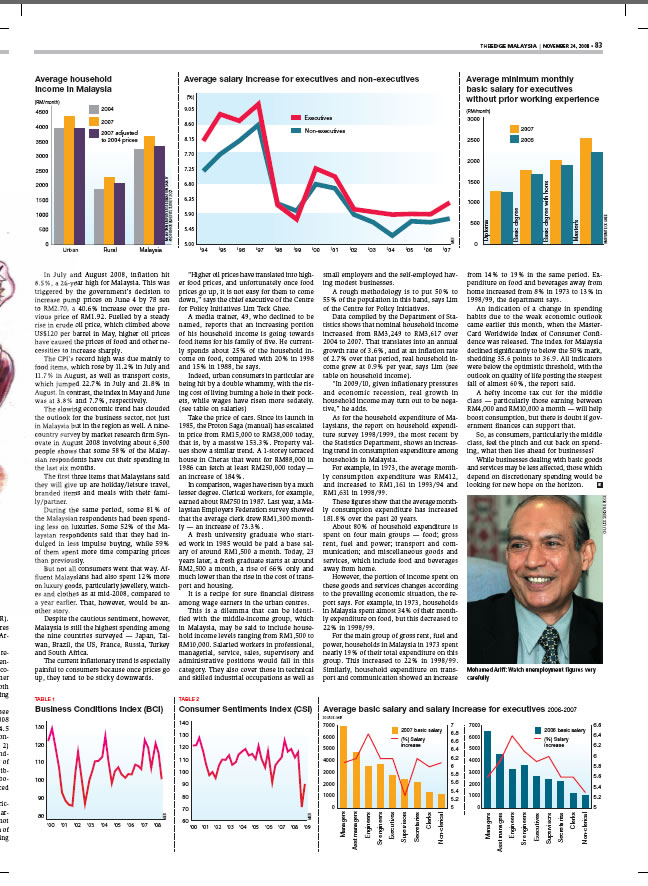 In July and August 2008, inflation hit 8.5%, a 26-year high for Malaysia. This was triggered by the government’s decision to increase pump prices on June 4 by 78 sen to RM2.70, a 40.6% increase over the previous rise of RM1.92. Fuelled by a steady rise in crude oil price, which climbed above US$120 per barrel in May, higher oil prices have caused the prices of food and other necessities to increase sharply.
The CPI’s record high was due mainly to food items, which rose by 11.2% in July and 11.7% in August, as well as transport costs,which jumped 22.7% in July and 21.8% in August. In contrast, the index in May and June as at 3.8% and 7.7%, respectively.
The slowing economic trend has clouded the outlook for the business sector, not just in Malaysia but in the region as well. A ninecountry survey by market research firm Synovate in August 2008 involving about 6,500 eople shows that some 58% of the Malaysian respondents have cut their spending in the last six months.
The first three items that Malaysians said they will give up are holiday/leisure travel,branded items and meals with their family/partner.
During the same period, some 81% of the Malaysian respondents had been spending less on luxuries. Some 52% of the Malaysian respondents said that they had indulged in less impulse buying, while 59% of them spent more time comparing prices than previously.
But not all consumers went that way. Affluent Malaysians had also spent 12% more on luxury goods, particularly jewellery, watches and clothes as at mid-2008, compared to a year earlier. That, however, would be another story.
Despite the cautious sentiment, however, Malaysia is still the highest spending among the nine countries surveyed — Japan, Taiwan,Brazil, the US, France, Russia, Turkey and South Africa.
The current inflationary trend is especially painful to consumers because once prices go up, they tend to be sticky downwards.
“Higher oil prices have translated into higher food prices, and unfortunately once food prices go up, it is not easy for them to come down,??? says the chief executive of the Centre for Policy Initiatives Lim Teck Ghee.