INTRODUCTION: The state of Perak has been plunged into a state of politcal chaos and uncertainty in the past few days when the Pakatan Rakyat-led government lost its 32-28 majority in the State Assembly following the switching of their political allegiance by four State Asemblymen on Wednesday, February 4, 2009, resulting in a “hung” assembly. Two assemblymen from PKR and one from DAP left their respective parties to become independents allied to BN, and the Bota state assemblyman who had recently joined PKR after defecting from UMNO, then returned to BN — creating a situation that has become essentially a Constitutional Crisis with an impact going beyond the borders of the Silver state.
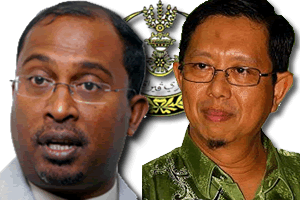
This has reached a unique climax with “two” state governments as of Thursday, February 6, 2009 both claiming to be the legitimate government — one headed by newly-appointed Mentri Besar Dr Zambry Abdul Kadir (UMNO – Pangkor) and the other led by “incumbent” MB Mohammad Nizar Jamaluddin.
Following are excerpts from published commentaries as well as news reports, with the focus on the constitutional and ethical issues at the heart of this important controversy which will continue for a long time to come. — YL Chong, Editor, CPI
Comments from Prominent Commentators
(1) By Tengku Razaleigh Hamzah, former Finance Minister:
Constitutional points
“The Constitution and the role of the Ruler in such crises must be respected.
The defections may or may not topple the government of Perak, but some of us are behaving as if they have instantaneously transferred the government to BN. Defections are not the basis for the formation of a government. Elections are. Governments are formed after citizens have expressed their choice through free and fair elections. Our Constitution specifies a formal process for the formation of a government. The Ruler is sworn to uphold and protect this constitutional process. From among the elected representatives, the Ruler appoints as his Menteri Besar the individual who in his opinion commands the confidence of the majority in the assembly, or dewan. This choice belongs to him alone, although thereafter the Assembly may reject his choice by a vote of no confidence in the dewan. The Ruler’s powers and those of the legislative assembly act as checks and balances on each other.
Ethical and political issues
“The ethical and political issues coincide because ethical failures are at the core of our political problem. Umno is in critical condition. Our biggest challenge, both as a party and as the governing party, is to tackle corruption at every level. We are under close public scrutiny in addressing this problem. Unless we implement radical reforms and are seen to be doing so, we are finished politically come next election.
Instead we are now seen to be “winning back??? Perak with the crossover of exactly the kind of low calibre individuals, as one commentator has put it, that we should shun.
Two of the assemblymen whose allegiance we have suddenly gained are under investigation for corruption. I was clearly wrong about the integrity of the assemblyman from Bota. His justification for his record-breaking ten day double-hop is an insult to the public’s intelligence and nauseating in its insincerity.
We are a parliamentary democracy .
“At both state and federal level, governments are formed only after the people have expressed their will by electing their representatives to the legislative assembly. In the states, these are the state legislative assemblies, or Dewan Undangan Negeri. In the Federal government, this is the lower house of Parliament.
We are a constitutional monarchy that preserves the sovereignty of the Malay Rulers.
Acting on behalf of the people, and with the executive powers of the government vested in him, the Ruler appoints as his Chief Minister the member who in his view commands the confidence of the majority of the members of the assembly. The Ruler’s discretion in this choice is absolute. However his choice can be tested by a vote of confidence in the assembly when it convenes formally.
Two principles need clarifying in the light of (today’s) events (on February 4, 2009):
“First, the government of the day is established according to rules and principles codified in the Constitution. This is the difference between legitimately formed government and tyranny, which is rule by the law of the jungle.
Second, legitimate constitutional government draws all its authority from the consent of the people and only from that consent. The people consent because it is their government formed according to their constitution, whose leaders they have chosen through free and fair elections.
We need to test that consent periodically. At key points such as when governments are to be formed or to be dissolved, the Constitution provides for formal, definitive tests to find out how much of the people’s ‘consent’, or support, a government really has.
So we conduct elections to test how much support a candidate for leadership has among the people. The question is posed in elections governed by rules and oversight agreed ahead of time. If those elections are not held, or if there is some doubt that they are free and fair, then the question of legitimate leadership is not determined. It doesn’t matter how many men with flaming torches march chanting your name in the middle of the night. You need to prove you have the support of voters in a free and fair election.
Similarly, the Constitution provides for a definitive way to test if the Chief Minister or the Prime Minister commands a majority in the dewan or in Parliament, as the case may be. We put the question to a vote of confidence on the floor of the Dewan. Only the answer of the assembly counts. It doesn’t matter how many sworn statements, defections, press conferences, and declarations you have, nor what forms of advertisement, display, inducement or force you bring to bear on the question.
To formally test the mandate of the current government, whether in Perak, Sabah or the Federal government, the question must either be put to the people through state elections, or to the assemblymen through a formal vote in the dewan. These are the only tests that count in our constitutional democracy.
This is what it means to be a parliamentary democracy. To remove and install governments in any other way is to violate the Constitution, erode the rule of law, and to run the risk of forming an illegal government.
Legitimate authority can only be established through the democratic means spelled out in our constitution. Rightful authority is an entirely different thing from the brute power that can be bought, sold or seized by force.
The invisible laws make our government, nation and society possible. I won’t begin to describe the harm we would do these things if we began to ratify power achieved without regard for the rule of law in this country.”
For Tengku Razaleigh’s full commentary, surf here — link: http://razaleigh.com/2009/02/05/the-longer-term/
(2) By Dr Lim Teck Ghee, Director of the Centre for Policy Initiatives (CPI)
The legal and constitutional grounds relating to concern as to whether Perak royalty has overstepped its constitutional authority in its recent decision on the State Government is as follows:
In the State of Perak, the Constitution and the Federal Constitution, read together, is supreme. Article VII of theState Constitution states:
“His Highness shall act towards all his subjects and all persons commorant within the state in an impartial manner, governing according to law … .”
The constitutional steps of appointing and removing a Mentri Besar are express and without ambiguity. Firstly, it is sequential. The Mentri Besar is first appointed, followed by the Members of the Executive Council, on the advice of the Mentri Besar. While the appointment of the Mentri Besar is at the Sultan’s discretion,” it is governed by convention. But once appointed, the discretion ends, and the Mentri Besar cannot be removed, except by the operation of Article XVI (6) which states:
“If the Mentri Besar ceases to command the confidence of the majority of the members of the Legislative Assembly, then, unless at his request His Highness dissolves the Legislative Assembly, he shall tender the resignation of the Executive Council.”
This means that according to the law, the confidence of the majority of the Legislative Assembly cannot be decided by His Highness in isolation and the safest and most prudent way is by way of convening the Legislative Assembly. The status of the Mentri Besar is always subject to the majority of the Legislative Assembly. A decision taken out of the Legislative Assembly, or by opinions expressed outside the Assembly – even if this takes place within the Palace – is fraught with ambiguity and will be tainted by contestation. That is the clear and unambiguous meaning of constitutional democracy and of sound governance according to the rule of law and sound principles of constitutionalism. The Legislative Assembly is the best place to ascertain the will of the people. Any other mode will attract criticism and speculation of partisanship of which a Constitutional Monarch ought not to be embroiled with .
(3) In “Welcome to Perak, a state with two MBs? “, Adib Zalkapli reported from Ipoh on Feb 7 that:
“Datuk Seri Nizar Jamaluddin appears determined to show up what Pakatan Rakyat contends is an illegitimate Barisan Nasional government that was sworn-in by Sultan Azlan Shah yesterday.
He is also determined to claim as legitimate his administration — today the embattled Nizar, called a traitor and a sore loser by Umno and BN leaders, chaired a meeting of his state executive councillors.
The meeting was held at the official menteri besar’s residence next the city’s landmark fountained roundabout, a short one-minute drive from Istana Kinta, the Ipoh palace of Sultan Azlan Shah.
Earlier this week, Sultan Azlan Shah asked for Nizar’s resignation, to which the latter refused. The Ruler then declared the menteri besar’s post vacant and promptly swore in Umno’s Datuk Dr Zambry Abdul Kadir as the new menteri besar.
Today’s meeting is in line with Nizar’s contention that he had not been sacked as MB, as PR leaders contend a state Ruler does not have the power to dismiss because such powers lie only with the state legislature through a vote of no confidence.
It is also meant to shore up his arguments in what is now a roiling constitutional debate, and will likely be part of his legal case when the political impasse ends up in the courts, in a situation which is looking likely.
Nizar has now turned the official menteri besar’s residence into his “seat of government,” with party supporters guarding the compound while policemen watch on from outside.
So far, neither the new state government nor the police have indicated they intend to forcefully evict him.
(4) In “A Shameful Day in Perak”, Mohd Multatuli wrote:
In a less politicised bureaucracy (than what we have) the Election Commission takes the instructions of the Speaker of the House at face value. It is not in its remit to question the legality or otherwise of resignations. That remit lies with the courts. But then Malaysia’s bureaucracy is highly politicised – from the uniform services to the civil service.
It is well known that in Perak civil servants have gone out of their way to obstruct the new government and that made the transition of power difficult. It is not surprising therefore that the State Secretary acted in such haste to demand that the MB and all Ex-Co Members vacate their offices and return the keys to the week old new official cars, even before the dust has settled.
We have a funny setup here. In most Constitutional Monarchies the titular head (be it the sultan or the Queen of Britain or the Netherlands) takes the advice of the Prime Minister (or in this case the Chief Minister/MB of the state). The party leader in power does not request that parliament or the state assembly be dissolved, it ‘advises’ the titular head – an advice which must be taken.
In the case of Perak it seems that the sultan has a big say in the formation of the state government (irrespective of how the rakyat voted) and it can overrule the democratic tradition where the largest party has the biggest say in the formation of the government (as it did March 2008); if he thinks it is in the best interest of the state. Whatever the electorate thinks it would seem that ultimately what the sultan says goes. This is most unsatisfactory – to depend on the wisdom of one person.
The sultan rejected the request of the Menteri Besar to dissolve the State Assembly. That is his prerogative. However the unpopularity of his decision to allow a takeover of the government by the BN Opposition, makes it incumbent on him to explain his decision as it will have a profound effect on the people.
It would be difficult to fathom the sultan’s reasoning behind his decision.
A new state government based on one double-party hopper and three independents cannot be stable, especially when they have decamped under dubious circumstances.
Two of the independents have corruption charges hanging over them. What if they are found guilty? Of course the cynical amongst us will say that a deal has been done and that they will never be charged (for lack of evidence?). I really don’t know. But then our courts are not known for their judicial independence.
The new state government will essentially be an UMNO government (MCA has one state assembly person). Can a racialist party whose constitution excludes all other races and whose agenda is racially bias really look after the interests of the other 50% of Perakeans? To accept such a government is tantamount to disenfranchising those who do not fit in.
Can this be fair?
There could be other reasons why the sultan has taken the decision he did – reasons we will never know.
However it is common knowledge that the sultan got on well with the previous administration which has been generous in granting timber concessions, quarry licences and selling cheap prime land to privileged companies.
One wonders why the sultan has made his decision with such unseemly haste when it took him nearly a month to install the PR government after March 8?
It may be within his legal right to do what he did but in a parliamentary democracy governments are not sacked by the sultan, they lose power when they do not have the numbers. This can only be tested in the state assembly through a vote of no confidence by the opposition. Why has the sultan not allowed that process to play out? To decide that BN has got the numbers after a brief interview with three politicians no reasonable person would regard as reliable, is most curious.
The sultan should have asked BN to prove it has the numbers in the state assembly!
This decision has cast doubts on the political neutrality of the sultan. It has undone the favourable perception the Perak royalty has garnered recently.
The sultan has made his decision but this by no means is the end of the matter – not by a long chalk. The drama has a long way to play out yet.
Meanwhile one casualty of this unholy mess is democracy and due process, the other casualty is the sultan’s credibility.
Daulat Tuanku!
(5) In “Perak, A Constitutional Crisis“, Malik Imtiaz Sarwar wrote:
It must be borne in mind that:
* as noted above Article 16(6) is specifically directed to a no-confidence scenario, that is the incumbent Mentri Besar can seek the dissolution of the Assembly upon his having ceased to command the confidence of the majority
* Article 36(2) however provides more generally that His Highness has the power to dissolve the assembly. It is clear that this provision is aimed at allowing His Highness to dissolve the Assembly for other reasons thought to be appropriate
* as a matter of law His Highness is empowered to do what is permitted under the Perak Constitution and the Federal Constitution. This is the essence of a constitutional monarchy
* the Perak Constitution does not empower His Highness to dismiss the Mentri Besar. The manner in which the Mentri Besar is to be removed from office is as provided for under Article 16(6), through a refusal to dissolve the Assembly at the request of the Mentri Besar when the Mentri Besar has ceased to command the confidence of the majority of the Assembly.
It is apparent that His Highness had moved on the assumption that the request for dissolution was prompted by the Mentri Besar having ceased to command the confidence of the majority. This may have been based on a misapprehension of the situation and the appeal to the Sultan to dissolve the Assembly for reasons other than confidence. If so, then the directive to resign was arguably not tenable.
However, it could be said that all things considered His Highness had come to the conclusion that in any event the Mentri Besar no longer commanded confidence. In this context, the central question is whether His Highness was empowered to conclude that the incumbent Mentri Besar no longer commanded the confidence of the Assembly without there having been a vote of no confidence.
There is precedent. The Federal Court had in 1966 (Stephan Kalong Ningkam) determined that a similar provision of the Sarawak Constitution required there to be a vote of no confidence taken in the Assembly before the Chief Minister was obliged to resign.
(6) In “Zaid says governments should not be overturned in private”, The Malaysian Insider reported on Feb 7 that:
“‘The way Datuk Zaid Ibrahim sees it, the constitutional crisis in Perak could have been easily avoided — if only all the political players accepted that Malaysia was a democracy, where political questions should be resolved in the legislature and not behind closed doors in a palace.
The former de facto Law Minister said that instead of beating a path to the istana in Kuala Kangsar, Barisan Nasional and Pakatan Rakyat should have tested their support in the state assembly through a show of hands.
“Having a show of support anywhere outside the proper arena is inappropriate. Parliaments all over the world have made it clear: This is how you do it. Just go to chambers and take a vote, ” he said, noting that in a democracy and where there is public interest at stake, it is best to resolve issues in an open forum.’
(7) Josh Hong in his column at malaysiakini.com, wrote:
“We are all Perakians now!”
In Malaysia, they first came for the Kelantanese,
and I didn’t speak up because I wasn’t a Kelantanese.
Then they came for the Sabahans,
and I didn’t speak up because I wasn’t a Sabahan.
Then they came for the Islamists,
and I didn’t speak up because I wasn’t a Muslim.
Then they came for the Hindus,
and I didn’t speak up because I was not a Hindu.
Then they came for the Perakians,
And I didn’t speak up because I was not an anak Perak.
Then they came for me —
and by that time no one was left to speak up.
(adapted from Pastor Martin Niemöller’s anti-Nazi statement)
I know it is a cliché, but in this anguished moment, when words fail to express the anger and the sorrow that so many people feel over the dramatic turn of events in Perak, the first thing that comes to my mind is: We are all Perakians now!
We have come a long way since the political tsunami last March, and the wheel of history must not be allowed to move backward. The effects of the political baptism that had imparted hope and aspirations to the people cannot be annihilated in such a despicable manner, certainly not by a political party that, despite the heavy electoral losses, refuses to root out corruption in its own midst but is bent on shortchanging the people, treating the popular will even worse than dust.