 Critical Visions and Sustainable Eco-urbanism
Introduction
Eco-cities is now a fashionable brand to be proudly displayed and identified with. This feedback workshop from the various cities in the region will certainly be useful to compare the experiences and effectiveness of actions taken. On the theoretical level, I wish to share with you all the challenges in the broader context towards achieving a liveable and sustainable environment in East Asian cities.
The analysis will go beyond the applications of present known knowledge and will base on the feedforward[i] approach into the unfamiliar territory of cutting-edge thinking and fundamental changes in the spirit of the post-modern which I have characterised as pluralism, rebelliousness, tolerance of differences, and the firm commitment towards vigorously investigating the present untested solutions of new knowledge broadly defined and embraced within the context of radical cultural studies.
My presentation will be in two parts. First, I will discuss three critical interdependent overview. They are: – 1) escalating climatic crisis and sustainability; 2) unprecedented global financial turmoil and new development model; and 3) Asian urbanism and chaotic order[ii]. Second, selected issues of particular relevance to eco-urbanism are identified. They are: – 1) sustainable and affordable transportation; 2) energy efficient green buildings; 3) retrofitting; 4) urban agriculture; and 5) recycling.
Critical Overview
1. Climatic crisis and sustainability — After two decades of largely ineffective international declarations and numerous individual efforts to address the escalating global climatic crisis, conditions are still deteriorating and many serious warning signs are already here. We have reached a moment of truth. Our world is now nearing the dangerous tipping points of environmental calamity which would last for a long period of time and are difficult to arrest and reverse. However, there is a note of optimism that the world is now in the dynamic stage of cutting-edge technological and energy revolution. Furthermore, it has recognised the abundance of available renewable energy resources and their possible effective applications. (See figure 1) [iii] A low-sustainable carbon energy global economy is possible, though the road ahead will be challenging and at least in the beginning, expensive. Major mind-set policy changes are essential to overcome the current obsessions in maximising profit and efficiency of the already known, and to encourage creative, innovative ideas in untested territories. We need clear visions and strong collective commitments in achieving a creative and vibrant living environment in the context of a harmonious equitable world for everyone.
[i] Feedforward control can be likened to learned responses to known cues. Feedback control is reactive; feedforward control is proactive.
[ii] William S.W Lim, “Asian New Urbanism??? in Asian New Urbanism (Singapore: Select Publishing, 1998): pp 14-32.
[iii] Data put together by Worldwatch Institute from various sources. See Christopher Flavin, Worldwatch Report 178, Low-Carbon Energy: A Roadmap (Washington, DC: Worldwatch Institute, 2008).
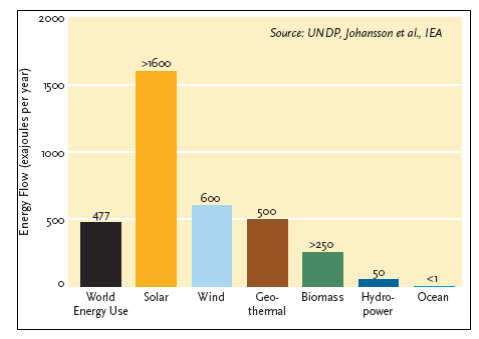
Figure 1: Estimates of Available Energy Resources Using Today’s Technology
To achieve a truly sustainable world is no longer just a utopian dream. Essential initiatives include a large-scale shift to carbon-free sources of energy[i], applications of major advances in energy efficiency[ii], global population stabilization[iii], protecting and restoring forests, efficient eco-urbanism and dramatic re-orientation in values and life-styles from the philosophy of greed as well as excessive and wasteful consumerism. Comprehensive sustainable development requires a long-term approach and public commitment well beyond the private business practices with their other priorities and shorter-term considerations. However, we must recognise that many developing countries still require decades of rapid economic growth, and at the same time, the need to minimise pollution and wasteful consumption as well as to achieve an ecologically sustainable economy.
1. Global financial turmoil and new development model — The severity of global financial downward turmoil is unprecedented since the Great Depression in the early 20th century. Much of the basic operating assumptions of neo-liberal capitalism such as deregulations, the Washington Consensus[iv] and free trade have been challenged. The illusionary utopian culture and growth by privileging the super-rich and permitting ruthless manipulation of major financial instruments have been totally exposed. The culture of greed is now debunked. Great turbulence in commodity, food and energy prices has added more pain. Furthermore, the crisis today has seriously disrupted the export-oriented trade resulting in major job losses, particularly in many Asian emerging economies. At the meantime, western governments led by the United States are introducing huge financial supports and stimulus packages.
Since the late 90s, major new players from the emerging economies are increasingly claiming their rightful voices in formulating the global agenda. Though somewhat reluctantly, the inevitable power-sharing and cross cultural recognition are now accepted by the West. It is in this context that China’s response should be examined. The word crisis in Chinese (??) comprises two characters meaning both danger (??) and opportunity (??). It is therefore psychologically ingrained in the Chinese psyche to simultaneously tackle the multiple dangers and explore and uncover new opportunities. This largely explains the quick response of the Chinese government to attempt a new development model by critically reviewing, analysing and re-defining their development strategies, environmental, social and economic priorities and income disparity particularly between the urban and rural communities with a firm political commitment to an unprecedented huge financial package. A new development model for the developing countries is now clearly emerging given priorities to renewable energy, locally based job creation, eco-urbanism and environmental sustainability, as well as to decrease income disparity between rural and urban and within cities, and to introduce fair trade instead of the present exploitative and western-biased free trade[v].
2. Asian urbanism and chaotic order — Traditionally, Asian urbanism is differently structured and has overtime developed organically. Streets in these cities are dynamic and bubbling with energy and vibrancy. Asian cityscape is often characterized as a zone of fuzziness where the public and private intermingle, and where the edges of buildings are fluid and constantly changing. “In the tradition of most East Asian civilizations, a ‘public’ understood in the sense of ‘domain’ in opposition to the ‘private’ does not exist.???[vi]
In recent decades, economic exigencies in many Asian cities have demanded the explosive expansion of urban centres. Following the United States capitalist model[vii], traditional downtowns and much of the adjoining areas are demolished to accommodate the modernist infrastructure and financial facilities. When time and where space are compressed immensely, many Asian cities experience the environmental shock of pre-modern and post-modern conditions simultaneously, and in a compact hybrid of contradictions. However, most Asian cities today still maintain their vibrancy because of the chaotic order, pluralistic richness and unintentional complexity. Besides the façade of western modernity along main streets resides a restless, indigenous Asian peculiarity that needs to be better understood.
It is in this context that I have strongly argued in the section Multiple Modernities and Contemporariness in my recent book entitled Asian Alterity[viii] that many universalistic assumptions of Eurocentric modernity are no longer viable paradigms for the non-West to understand contemporary society. In the dynamic global changes of contemporariness, the discourse and applications of the modernity in each country and its cities must evolve within its own traditions and culture.[ix] To quote Charles Taylor: – “Some of these changes may be parallel, but they will not converge, because new differences will emerge from the old.???[x]
Eco-urbanism
The present single-minded focus by the advanced economies on the pursuit of a high-technological global future and excessive consumerism has left in its wake an unsustainable exploitation of the earth’s global resources at the expense particularly of the poor and under-privileged. In the next few decades, unprecedented explosion of the urban population in many emerging economies will continue. However, given the limited resources available in these economies, the present elitist urban practices based on the model of western capitalist modernism are clearly not viable. Sadly, evictions of farmers to build golf courses and high-income low density residential developments are still continuing unabated. In response to challenges of global sustainability and the present global financial crisis, there is now an increasing awareness in the essentiality of public ethical responsibility beyond obsessive priority for monetary gain and the illusionary unrealisable urban imagery.
A truly sustainable world and a liveable environment for everyone is now a necessity and a challenging task. It is no longer just a utopian dream. Renewable technologies, energy efficiency and fundamental policy re-orientation will allow developing countries to increase their reliance on indigenous resources. However, to write critically about sustainability and affordability, as well as liveable and vibrant urban environment, we must ask some hard questions. Sustainability for whom – who benefits and who loses?
1) Transportation — Notwithstanding the rapid shift to other more efficient energy options, extensive car usage is still the main culprit of urban environmental crisis, and the destruction of the vibrancy in street-life. Public transport ranging from subways, buses and taxis to jeepneys and bicycle rickshaws is an essential source of mobility for the majority and occupies a critical role in urban workability. Cycling and walking should certainly be encouraged with city-wide networks of bicycle lanes and walkways.[xi] For cities in the emerging economies, millions will benefit by returning and providing cyclists their rightful status and facilities.
2) Green buildings — The greatest potential for energy savings in cities lies in the most basic element of energy consumption i.e. in buildings. Effective actions include the enforcement for new constructions using integration of design with multiple energy efficiency measures in response to local climatic conditions and technical capabilities, the use of compact fluorescent light bulbs (CFLs) as well as mounting solar electric generators on rooftops. Furthermore, Asian cities need to discard the illusionary symbolism of modernity with very tall buildings as these buildings are expensive to construct and maintain.[xii] The recent phenomenon in search of the iconic by commissioning international star architects to produce fashionable theme-park trendy images must be contested and debunked.[xiii]
3) Retrofitting — The sheer number of old buildings that can benefit from retrofitting is staggering. According to an international report, the largest potential within the building sector for reducing green-house gases by 2030 is in retrofitting and upgrading equipment.[xiv] Retrofitting maximises the use of existing architectural resources. To quote Cui Kai, “Renovation promises sustainability – appeals to an appreciation for history and culture – a city, a block, a building can never be what it is but for decades and centuries of construction and renewal.???[xv]
4) Urban agriculture — I was asked after my lecture in Ho Chi Minh City last year whether rich farmland should be preserved within the metropolitan area.[xvi] My answer was a strong affirmative, as these farms are very productive and are also invaluable in many other ways. They include production of fresh food and vegetables, reduction on transportation load and enrichment of environmental quality. In larger farms, renewable energy such as wind power can be introduced and extensive tree planting and public recreation facilities can be incorporated.
5) Recycling — Waste recycling makes an important contribution to reducing energy usage and pollution as well as minimising land filling and incinerating waste. In the developed economies, recycling now generates large revenue and new employment opportunities. However, collecting waste for recycling in many poor countries sometimes entail dirty, undesirable and even dangerous work, and it is often badly paid. With rapidly improving technology and lowering cost, recycling waste water even for drinking purpose will soon be a viable option for many densely populated Asian cities. In Singapore, recycled water is now supplied at a competitive cost and will be able to constitute 30 per cent of the state’s total consumption needs by 2010.[xvii]
Conclusion
We must understand the strong linkages and complex interdependency of sustainable development, quality of urban life and spatial justice. To provide the basic needs and amenities for the whole community particularly the poor is not enough. We have to expand the concept of human rights and social justice to include many ethical urban actions such as accessibility and affordability of public transport, healthcare and education as well as to enjoy the facilities of public parks and cultural facilities such as museums, art galleries and libraries. However, this will only be achievable with deliberate public policies towards generous selective subsidization and broad-based community supports.
This analysis is by no means exhaustive. To achieve a truly liveable and environmentally sustainable eco-city is a difficult task. The urgent challenge today is for Asian societies to pursue an alternative viable development strategy in order to transcend and redefine the dominant logic of materialism and commodification. This can be possible with a strong broad vision of global responsibility, a firm commitment to social justice and an active grass-root participation of the community.
[i] Christopher Flavin, Worldwatch Report 178, Low-Carbon Energy: A Roadmap (Washington, DC: Worldwatch Institute, 2008).
[ii] See Lester R. Brown, Plan B 3.0 Mobilizing to Save Civilization (New York and London: W.W Norton & Company, 2008): Chapter 11 Raising Energy Efficiency, pp 213-236.
[iii] According to the United Nations, the world population is expected to reach 9.2 billion in 2050 and to be increasing at a slower pace by about 30 million persons annually at that time. See World Population Prospects: The 2006 Revision, Highlights (United Nations, February 2005).
[iv] Jomo K.S and Ben Fine, ed., The New Development Economics – After the Washington Consensus (New York: Zed Books, 2006).
[v] Wolfgang Sachs and Tilman Santarius, Fair Future: Resource Conflicts, Security and Global Justice, (London & New York: Zed Books, 2007): Section “Fair trade instead of free trade??? in Chapter 6 Agreements for Fairness and Ecology, pp 196-215. Let me quote from this book, “Between 1980 and 2000, the world market prices of eighteen important agricultural goods fell by an average of 25 per cent – and by as much as 47 per cent for cotton, 64 per cent for coffee, 60.8 per cent for rice, 71.1 per cent for cocoa and 76.6 per cent for sugar???: pp 95 and “US tariffs on sugar were set at 244 per cent of the import price and on groundnuts at 174 per cent, while EU tariffs on beef and wheat were fixed at 213 and 168 per cent respectively???: pp 203.
[vi] Wen-liang Kuo, “Optically Irrelevant: A Hypothetical Account of an East Asian Model of Perception??? in Chaolee Kuo, ed., Dark Discourse: Reflections of Taiwan City Culture, (National Taiwan Museum of Fine Arts, 2008): pp 49-69.
[vii] It is important to realize that notwithstanding the vast destruction of WWII, no traditional central city area in any major European city has been deliberately destroyed for commercial-oriented development.
[viii] See William S.W Lim, Asian Alterity (Singapore: World Scientific Publishing Co., 2008): Section 1 “Multiple Modernities and Contemporariness??? in Chapter 2 Modernities, pp 56-62.
[ix] Refer to a recent article by Chua Beng Huat, “Disrupting Hegemonic Liberalism: Singapore in Question??? delivered at a public lecture at Asia Research Institute, National University of Singapore (Unpublished paper, 2008) and to quote from the article, “There is therefore discursive space for a conceptualization of a democratic polity that is not liberal but one that privileges the social and to insert this conceptualization into the theorization of politics at the comparative and global scale.???
[x] Charles Taylor, “Two Theories of Modernity??? in Dilip Parameshwar Gaonkar, ed., Alternative Modernities, (Durham: Duke University Press, 2001): pp 172.
[xi] Cycling is now a major mode of urban transport in many major European cities such as Amsterdam and Paris. See Brown, Plan B 3.0 Mobilizing to Save Civilization, “The surge to 500 million bicycle owners in China since 1978 provided the greatest increase in human mobility in history…it is bicycles that provide personal mobility for hundreds of millions of Chinese???: pp 200.
[xii] Peter Buchanan, “The Tower: An Anachronism Awaiting Rebirth???? in Harvard Design Magazine, Issue 26 (2007), pp 5-29. To quote from this article, “Sustainability requires not only that we lessen our ecological impacts, but also that we create the urban and cultural frameworks in which we can attain full humanity, in contact with self, others, and nature. This might be the real reason that the tower seems an anachronism???: pp 14.
[xiii] William S.W Lim, “Debunking the Icon-Myth??? in SA Singapore Architect, Issue 247 (2008), pp 48-51.
[xiv] Intergovernmental Panel on Climate Change (IPCC), Climate Change 2007: Mitigation of Climate Change, Contribution of Working Group III to the Fourth Assessment Report of the IPCC (Cambridge, UK and New York: Cambridge University Press, 2007).
[xv] See Foreword by Cui Kai in Yu Bing, ed., Domus+ New Renovation Projects (China Architecture and Building Press, 2008).
[xvi] William S.W Lim’s lecture on “Understanding Asian Ethical Urbanism??? to University of Architecture, Ho Chi Minh City, Vietnam in March 2008.
[xvii] PUB Pure Annual Report 2007/2008 (Singapore: MediaCorp Pte Ltd).