Malaysia: Challenge of Education in a Multicultural Setting

Kuala Lumpur, 24 February, 2011 – UCSI University’s Faculty of Economics and Policy Science together with MiDAS @ UCSI University and the Institute for Democracy and Economic Affairs (IDEAS) Malaysia, organised a policy roundtable discussion titled “Education in a Multicultural Setting.” The main speaker for the event was Dr Azly Rahman, an educator in New Jersey, USA, and also a Malaysiakini columnist. The event was moderated by Dato Dr Ibrahim Bajunid, Deputy Vice Chancellor for INTI International University, with Dr Lim Teck Ghee, Senior Professorial Researcher for MiDAS @ UCSI University as commentator. The event was attended by educationists, activists, parents and several representatives from non-governmental organizations.
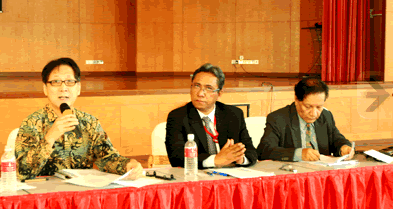
From left: Dr Lim Teck Ghee, Dr Azly Rahman & Dato Dr Ibrahim Bajunid
photo courtesy of USCI
The roundtable discussion closely talked about the Malaysian education system, and how it fits into Malaysia’s multicultural society. Among the issues forwarded by Dr Azly Rahman was the impact of a multi-school system, the school as a tool in nation building, and parents’ preferences and trends in choosing the medium of instruction.
According to Dr Azly, many cultures in the school system results in multiple perspectives, many abilities and even disabilities. “The recent protest over the novel Interlok is just one such example on the complexity of the school system in Malaysia. The education system in Malaysia is turning into a ‘shopping mall’ where one can choose different education systems, and different mediums of instruction. While schools were once seen as tools for nation building, is this agenda being sacrificed now that there are multiple education systems? We need to explore this further.”
According to Dr Lim Teck Ghee, the current education system in Malaysia is in dire need for change as there is a lack of integration. “Malaysia will never truly be a melting pot of cultures, where race and religion won’t matter. We will always be diverse. Hence, the context of multiculturalism is not something we can runway from.”
He goes on to say that the notion of closing down vernacular schools, and introducing the national type schools to all is unrealistic, as 1 million out of 2.5 million school-going children are currently placed in vernacular schools. He also added that racial intolerance exists in national type schools as well. “What needs to happen is a revamp of the syllabus to address issues in the school system which have not been reformed since the past 3 to 4 decades.”
The event was among many other high profile events organised by the University’s Faculty of Economics and Policy Science, in a bid to encourage more critical thinking as well as to generate ideas on important national issues among members of the public as well as University students.