
 We speak these days of modern political “dynasties”. The Bhuttos in Pakistan, the Nehru-Gandhis in India, the Bandaranaikes in Sri Lanka, and now perhaps also the Lees in Singapore come readily to mind.
But strictly speaking these are not dynasties, sovereign and commanding ruling houses. Rather, they are closely-knit and often locally or regionally focused “power clusters”, more than just families but usually with a strong familial or kinship basis.
In this sense Malaysia too has a number of notable “dynasties” or power clusters, some in the Kedah-Penang northern zone and in the East Coast states, notably Kelantan. But none matches in its historical depth, its social density and complexity, and its contemporary political reach the great noble family network of Johor.
Products of the – in many ways unsettling – 19th century transformation of Johor society entailed by the British acquisition of Singapore, these families emerged and began to thrive, and in time consolidated their pre-eminent political and social position through their loyal clerical and administrative labour in the service of the royal house.
Displaced from Kampung Gelam to Teluk Belanga in Singapore, they began there to reshape themselves by reorienting their brightest children through modern education in both English and Malay. Gradually they relocated themselves across the narrow straits in the new Johor township. Recentered there, these notable state-serving families developed a social stability and coherence no less impressive than that of the royal house of Johor whom they served.
Of all these great state-serving families, none in time would prove more distinguished than those whom many designate as “the Onns of Johor”.
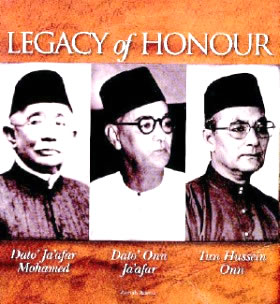
Zainah Anwar’s long-awaited account is centred upon three generations, three great scions, of that family whose own remarkable lives and politically fateful careers have underwritten the unparalleled pre-eminence which that family now enjoys.
First, Datuk Ja’afar Mohamed, the wise, firm and ever canny Mentri Besar of Johor from 1886 to 1919.
Second, his politically restless yet always inventive son, Datuk Onn Ja’far, the “stormy petrel” of the formative period of modern Johor and Malayan politics. Founder of Umno at the centre of an unprecedented movement of Malay national resistance to the Malayan Union in 1946, he was to find himself within a few years “on the outer”. He had become an outcast from the party he created and a bystander to the achievement of the Merdeka that he had inspired but which Umno would achieve without, even despite, him.
And, third in turn, his son Tun Hussein Onn, independent Malaysia’s third Prime Minister, unlikely in his accession to that position but unimpeachably honourable, painstaking, decent and deliberate in the discharge of its grave responsibilities.
Loyal service, and the idea of a political life not as the pursuit of personal power and advantage but above all as dutiful and honourable contribution, even at considerable cost to personal hopes and ambitions, was a key theme or leitmotif in the career of all three men.
Ja’afar came to, and long wielded, great power with enormous fidelity and discretion but in the end found himself sidelined, “yesterday’s man”, upon the accession of a new ruler.
The young Onn Ja’afar glimpsed and envisaged and then, in some detail, spelled out and sought to pursue a new kind of politics that his contemporaries, including the ruler, could not embrace. For a decade his lot was not the gratifying exercise of power but the endurance of lonely, penurious yet politically creative exile.
Again, later, after his failure to persuade Umno to see the future that he knew it must fully engage – a Malay-centred but by no means exclusively Malay future drawn solely to suit Malays on their preferred terms – he would face a second estrangement, this time not from his traditional ruler but his modern political creation, Umno itself.
In his turn, too, Tun Hussein Onn was to find that success as a modern politician in the age of materially-driven mass politics was possible only at the cost of his sense of personal and public decency, of his identity-defining sense of moral responsibility. He was not capable of that, he concluded when standing down from national leadership in 1981; if others were, let them take on the task.
If politics is about giving effect to an idea of “the good life”, then the life of politics should not be distasteful to “the good man”. Yet he could not endure it. He died (in 1990, aged 68) with his personal reputation intact but stigmatised by some as a political underachiever, slow on delivery.
Zainah Anwar’s book is about these three men and the family network in which their lives were grounded. It is also about the state of Johor and the distinctive way, through education in the modern administrative arts, that it fashioned to fend for itself in the modern world, in the face of advancing cultural modernity and outside aspirations. And it is about modern Malaysia as a whole, in which this family, the wider Johor noble elite, and the state of Johor itself have all played such a notable, and disproportionately large, role. How?
In an age of strife and near incessant armed conflict in Europe, one great family and nation, the Austrian Habsburgs, prevailed and even flourished through their distinctive recourse to other than warlike methods, notably the making of strategic family-based alliances. “Others may wage war,” their motto declared, “but you, happy Austria, marry!”
Like the European principalities, the late 19th and early 20th century Malay states and their leading territorial families were much given to fierce rivalry and war-like confrontation. Yet among them, those in Johor might have voiced a Habsburg-like claim.
***********************
The article above first appeared in ‘Sunday Star’ on May 22, 2011 and is reproduced here with permission from the author and the paper.