Users hang up on CAP call to ban mobile phones
By Rina De Silva , The New Straits Times
June 2, 2008
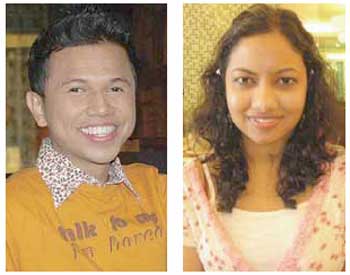
Shah Shamshiri (left) can’t imagine life without his trusty mobile phone, while V. Vijaya Sheila wants solid evidence showing the dangers of mobile phones.
KUALA LUMPUR: There is no conclusive evidence from global studies showing that mobile phones can cause cancer, said an oncologist.
Dr John Low said even the World Health Organisation had not made any recommendations to stop the usage of mobile phones.
Dr Low was commenting on the Consumers Association of Penang’s call to ban mobile phones.
The suggested ban came after a reported study by Australian-based neurosurgeon, Dr Vini Khurana, who said there was significant and increasing evidence to link mobile phone usage and certain brain tumours.
Dr Khurana said people should avoid using mobile phones wherever possible.
He added that governments and the mobile phone industry must take “immediate steps” to reduce exposure to radiation.
“It is anticipated that this danger has far broader public health ramifications than asbestos and smoking,” he said in the Internet news article.
He said that for the three billion mobile phone users worldwide, the health risks from using their phones far exceeded the danger from smoking.
According to the article, the study is being peer reviewed for publication in a scientific journal.
Dr Low said the scientific community would not accept any study if it was not published in a peer-review publication.
Consultant neurosurgeon Dr Jagdeep Nanra echoed Dr Low’s comments, adding that there was no medical evidence showing there was a need to keep mobile phones away from the brain or heart.
Dr Fuad Ismail, Hospital Universiti Kebangsaan Malay-sia’s clinical associate professor in the oncology department said: “The radiation from a mobile phone is too low to have any effects.
“It is extremely difficult to prove one way or another that it can cause any effects.”
Meanwhile, several mobile phone users fumed at CAP’s call for a ban.
Producer Marianne Chan said: “I think the ban is ridiculous. We have come to depend so much on the mobile phone for communication that it is going to be difficult to go without it.”
She said public phones could not be depended on, especially by busy people like her.
“Who can depend on public phones when they are hard to find and are often dirty and faulty?”
V. Vijaya Sheila said she would like to see solid evidence linking mobile phone usage to deaths caused by brain tumours.
“If there is no solid evidence, then the finding is just putting fear in people whose work and lifestyles revolve around the mobile phone,” she said.
Lyricist Shah Shamshiri, 30, said if the findings of the study were true, then mobile phone manufacturers should think about making more health-friendly phones.
“I have been a mobile phone user for over 10 years. I cannot imagine my life without one. It is so necessary that I can’t imagine how people ever lived without it.”
Senior manager Chrispian Chan said it would be difficult to take away the mobile phone as it had become a necessity.
“It will be like turning back the clock if we ban the mobile phone.”