The don with a large heart
By New Straits Times
May 24, 2008
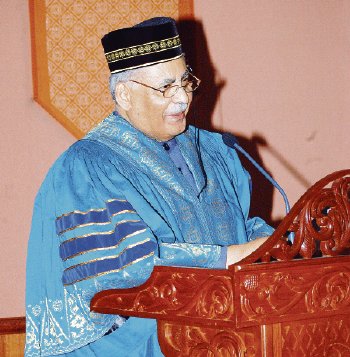
Datuk Dr Abdul Hamid Abu Sulayman at the convocation ceremony on May 20.
KUALA LUMPUR: How many of us would sacrifice every cent of our hard-earned money for the needy?
Datuk Dr Abdul Hamid Abu Sulayman is one of those who did.
Abdul Hamid never took his salary during his decade-long tenure as the International Islamic University Malaysia (IIUM) rector. He credited it into the Rector’s Fund, which he established for needy students and staff.
At the time of his departure from the university which he joined in 1988, he had also established the IIUM’s Endowment Fund and made a personal donation of RM400,000.
He received an honorary doctorate in education from the university on Tuesday.
IIUM president Tan Sri Sanusi Junid presented the award to Abdul Hamid at a special convocation ceremony at the university’s Gombak campus.
The doctorate was conferred in appreciation and recognition of the 71-year-old Abdul Hamid’s vast contributions to the development of the university and Muslims in general.
The educator’s list of achievements and plaudits makes for impressive reading, but what people will remember most about him is his extraordinary vision.
The vision is one which propelled IIUM to become a centre of educational excellence in the Muslim world during his tenure as the university’s second rector.
Among others Abdul Hamid, who holds bachelor’s and master’s degrees in politicalscience as well as a PhD in international relations, established a full-credit hour system in 1990 which provided the opportunity for gifted students to graduate earlier.
His introduction of a double degree system enabled students to broaden their intellectual depth. He also allowed ambitious pupils to take inter-disciplinary tracks and enforced compulsory IT courses for all of IIUM’s academic programmes.
He ensured high standards at the university by maintaining a strict minimum 80 per cent score requirement for undergraduate applicants and a CGPA of at least 3.0 for the postgraduate programmes.
Under his leadership, the number of academic programmes in the university rose from 19 in 1988 to 96 in 1998. The number of courses went up from 250 to 1,600.