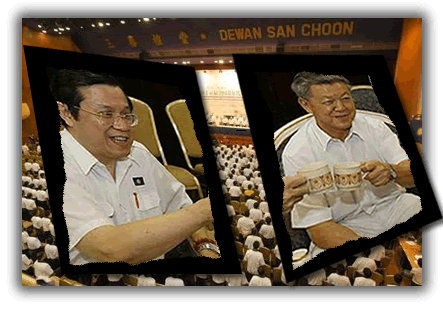
 The current friction between the Ong Tee Keat and Chua Soi Lek factions invokes a déjà vu recalling the challenge by Lim Ah Lek to Ling Liong Sik. History is repeating itself as the earlier fight similarly saw Umno imposing a peace formula upon Teams A and B, the emergence of a third force and MCA leaders looking upon federal ministership as the highest perk to be gained.
Since the 1970s, the MCA has been marginalized by Umno’s omnipresence and in recent years, it has been seen by large sections of the Chinese community as a ‘service centre’ rather than representing their political interests.
‘Service’ includes letter writing and representing the constituents in disputes with government departments and regulatory bodies to solve day-to-day problems. Since local councillors are appointed by the government, the MCA is almost always represented. The party gains political legitimacy by this method.
The origins of the 2005 MCA presidential contest go back to the 1999 General Elections (GE). At that time, MCA was led by Dr Ling Liong Sik who decisively moved MCA to a non-confrontational stand when it comes to Umno’s core issues.
Liong Sik’s idea was to work quietly with ‘progressive’ elements in Umno to promote Chinese interests and concentrate on areas such as post-secondary education to improve the lot of the ordinary Chinese, and to help small Chinese businesses.1
Liong Sik believed that such ‘sensitive’ issues – such as Chinese schools, language, and culture – are not not championed openly but best resolved quietly behind closed doors with Umno leaders.
The MCA, under Liong Sik, claimed success with this approach when the government approved Universiti Tunku Abdul Rahman (Utar). Critics, on the other hand, argued that Liong Sik was so close to Mahathir that MCA might as well be called the Mahathir Chinese Association and that MCA’s ‘closed door’ negotiations were nothing more than ‘closed door kowtowing’.
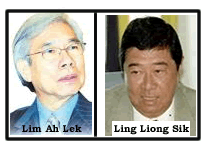 Prior to the 1999 GE, Lim Ah Lek, the deputy MCA president made it known that he wanted to retire and nominated his protégé, Chan Kong Choy, as his successor in the federal cabinet. Ah Lek, who comes from a wealthy family in Pahang, had no intention of seeking the party presidency; instead he wanted to promote Kong Choy.
According to Ah Lek, Liong Sik agreed to this ‘retirement’ deal (Nanyang Siang Pau, April 14, 2000). After the elections, Ong Ka Ting, Liong Sik’s protégé2 was made minister instead of Kong Choy, who remained a deputy minister. Ah Lek remained deputy president although he no longer held a ministerial post.3
Within a short period, the conflict between the No.1 and No.2 in the party became serious.4 Members began to call Liong Sik’s group ‘Team A’ while Ah Lek’s group was called ‘Team B’. Both sides accused each other of using ‘phantom’ members to try to fix upcoming party elections. In the interim, Liong Sik removed many Team B members from party positions, including removing Ah Lek as head of the party disciplinary committee.
At one MCA Youth meeting, there was even a fracas in which chairs were flung at each other.
Nanyang takeover: Turning point
In 2001, the conflict between Liong Sik and Ah Lek became very public after two years of shadow boxing. The issue that brought the conflict into the public arena was the Nanyang takeover affair.
Nanyang Siang Pau (NSP) is one of the two major Chinese-language dailies5 and widely seen as a quality paper with strong editorials and independent columnists. Many of its columnists, especially in its ‘Forum’ page, expressed pro-opposition, anti-government, and anti-MCA views when it comes to issues such as Chinese schools, language, and culture. Many of them see MCA as a tool of Umno for window-dressing purposes.
What irked the BN was NSP’s perceived role in the 2000 Lunas constituency by-election, which the BN lost to the opposition. The BN believed the anti-government slant by NSP helped the opposition to win over Chinese voters in Lunas, causing BN’s loss.
|
|
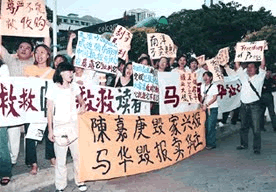
A few months later, it emerged that Huaren, a holding company owned by MCA, was attempting to take over Nanyang Holdings.6 Team B was vehemently against it and started to organize opposition to it. Part of the opposition stems from fear that once Team A gains control, it will pursue negative stories about Team B and, far more seriously, Team B would lose an avenue to get its side of the story about the Team A and Team B conflict out to the Chinese polity.7
Chinese journalists established the ‘Committee Against the Takeover of Nanyang Press by Political Party’ (CAT) to fight the takeover, citing editorial interference. Many Chinese-based NGOs supported CAT, arguing that if MCA was successful, there will no longer be an ‘independent’ voice in the Chinese media and damage ‘democracy’.8
Despite strong resistance from Team B and the Chinese community, Liong Sik prevailed on the MCA, and Huaren successfully took over Nanyang Press Holdings as controlling shareholder. By early 2002, the fallout from the Nanyang affair meant that everyone expected Team B to challenge Liong Sik for the presidency in the MCA assembly due later in the year.
Umno factor and party unity
The mood in the party was for change and confrontation. Unfortunately, the party elections did not take place. Liong Sik’s triumph card was that he had the support of Dr Mahathir Mohamad as his standing with the Umno leader had been given a boost by the 1999 GE results. Chinese voters had helped Umno to win in many marginal constituencies and MCA had performed well.9
Mahathir was worried that a split in MCA would affect Chinese votes for the BN in the next GE due in 2004. To forestall an open fight for the MCA presidency, Mahathir imposed a peace formula upon Teams A and B.10 Party elections were postponed until after the GE, both Ling Liong Sik and Lim Ah Lek were to ‘retire’ and be replaced by their respective protégés. All other party positions were ‘frozen’ until after the GE.
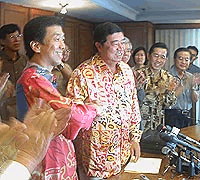 On May 23, 2003 Liong Sik resigned after 17 years at the helm, with Ah Lek resigning on the same day. Ong Ka Ting, long-standing protégé of Liong Sik, duly took over as party president, and Chan Kong Choy, protégé of Ah Lek, took over as deputy president.
In the March 2004 GE, a ‘united’ MCA performed to expectations. It won 31 of the 40 parliamentary seats it contested and 76 of 90 state seats.
With the GE over, both Team A and Team B geared up for the internal party elections scheduled for 2005. Many Team B members were bitter that despite the peace plan which was supposed to put a ‘freeze’ on the party, Ka Ting had marginalized many of them after the 2004 GE.
Unfortunately, the main beneficiary of the peace plan in Team B, Chan Kong Choy, refused to take on Ka Ting for the presidency. Moreover, there was no guarantee that Kong Choy would be able to defeat Ka Ting; on paper, Kong Choy was weaker than Ka Ting. In the meantime, Team A began to push for a ‘no contest’ for the top two party positions claiming that the 2004 GE was an endorsement for the Ong-Chan party leadership and that any contest would ‘destabilize’ the MCA.
In the end, the challenger came in the form of Jimmy Chua Jui Meng. Jui Meng, who was dropped by Ka Ting as Health Minister in 2004, decided to go for the presidency. Being appointed a federal minister is the highest perk given to an MCA leader and since Ka Ting was unlikely to nominate him for a cabinet position, Jui Meng really had nothing to lose.
Earlier, before Ka Ting ascended to the party presidency in 2003, Jui Meng had been trying to create a ‘third force’ or Team C in MCA. He apparently had plans to contest for the party presidency or, at the very least, the deputy presidency in the 2002 party elections. The peace formula which led to the postponement of the party elections had derailed his plans11and he was subsequently removed by Ka Ting as Health Minister after the 2004 GE. 12
The campaign was very much a one-sided affair. The Ong-Chan slate had the party machinery behind them and their ministerial positions gave them a distinct advantage. As ministers and party leaders, they could dish out the patronage to cement support.13 They also enjoyed extensive press coverage by the two Chinese dailies controlled by the MCA (NSP and China Press) and Sin Chew Jit Poh (controlled by a Sarawak tycoon) who backed Ka Ting’s leadership, in addition to favourable coverage in The Star.
The incumbents were also helped by the influence of Liong Sik whose extensive network in MCA built over his 17 years as president was largely intact. Ka Ting’s other distinct advantage was that his brother, Ka Chuan, was Perak MCA leader and could deliver a bloc vote from the state.
Another Liong Sik supporter, Chua Soi Lek, delivered another bloc vote from Johor state. Thus the Ong-Chan camp had every reason to think that it will get at least 75 per cent of the vote, with some confidently predicting 80 per cent.
Spokesmen for Chinese community
Chua Jui Meng, on the other hand, had the support of what’s left of Team B supporters and Oriental Daily, a Chinese paper with limited circulation.14 Jui Meng was quite well known to delegates given that he was a minister barely two years earlier. Being the underdog, he alleged that Ka Ting had resorted to “dirty tricks??? including stopping party delegates from meeting him and promoting cai tan or ‘menu’ politics.15
Jui Meng’s campaign received an unexpected boost when he won a television debate against Khairy Jamaluddin, deputy leader of Umno Youth a week before the MCA presidency poll. The debate concerned calls by Umno Youth for the New Economic Policy to be reinstituted. Jui Meng’s winning performance against Khairy, an Oxford graduate who spoke perfect English, saw his supporters distributing VCDs of the debate as ‘proof’ that Jui Meng would ‘fight’ for Chinese interests.16
In the end, Ong Ka Ting received 1,515 votes to Chua Jui Meng’s 819 votes. (refer to Table 1).
[Calculations: Assuming that Liong Sik controlled up to 30 percent of the delegates votes, this meant that Ka Ting was only able to get about 30-35 percent of the votes, which was hardly a strong endorsement of his leadership. Even assuming that Liong Sik only managed to influence 20 percent of the vote, Ka Ting was still short of the simple 50 percent majority.]
| 2005 MCA Poll Results |
|
|
| President |
number | votes % |
| Ong Ka Ting | 1,515 | 64.9 |
| Chua Jui Meng | 819 | 35.1 |
| Deputy President |
number | votes % |
| Chan Kong Choy | 1,315 | 61.9 |
| Ting Chew Peh | 738 | 34.7 |
| Chan Tse Yuen | 72 | 3.9 |
The strong showing by the challengers Jui Meng and Ting Chew Peh for deputy presidency was a surprise to many. Despite the overwhelming advantage, the Ong-Chan team could not deliver the ‘knockout blow’ (80 per cent and above) deemed by many as the threshold to claims of legitimacy to be leaders of the MCA, and by extension, spokesmen for the Chinese community in the government.
More of the same?
|
|
MCA worked in a restricted environment where Umno had the final word on all major policies. While the party represented Chinese interests, it could not challenge the notion of Malay political supremacy. It could never be equal to Umno and hence could not make demands on Umno.
At best MCA had to rely on Umno to accede to requests for a more equitable treatment of the Chinese community and to ensure that pro-bumiputera policies did not hurt them too much. In other words, it could only ‘influence’ policies but not change them. MCA provided an outlet for the Chinese to put their views directly to the Umno leadership and cabinet.
Delegates from both MCA understood this dilemma too well, and hence there was no need for the leadership aspirants to give any details of their political vision or policies other than say that they would protect the interests of the Chinese community in the BN coalition.
Ka Ting and Kong Choy are Chinese educated. Traditionally, the Umno leadership did not like Chinese-educated leaders and often claimed that they were Chinese chauvinists in their outlook (that is, they pushed Chinese issues such as Chinese education and culture too strongly).
Former MCA leaders such as Lee San Choon and Lee Kim Sai, deemed to be Chinese chauvinists, found themselves sidelined by Umno.
In summary, although the 2005 party elections in MCA generated a lot of heat, there was little substantial change in its internal politics. Personal ties, personal interests, and political payback were the norm, as in previous elections. The substantive change occurred only in MCA when term limits were imposed after the elections.
Whether this will change the internal dynamics remains to be seen but it is clear that the real problem for MCA is its relationship with Umno and ability to represent Chinese interests meaningfully in the confines of the BN coalition.
James Chin is a professor in Political Science.
________________________________
Editor’s note: The above is a condensed version of a paper first published by the Institute of Southeast Asian Studies in the ‘Contemporary Southeast Asia’ journal, Vol. 28, No. 1 (2006), pp. 70-87, and reproduced with permission from the author. The full text can be read here in pdf.
Footnotes:
- For an idea of how Ling thinks, see the following two books written by him: The Malaysian Chinese (1995) and The Future of the malaysian Chinese (1998).
- Ong Ka Ting served as Ling Liong Sik’s political secretary.
- By tradition, the MCA president and his deputy are automatically offered cabinet posts. At present the MCA holds four ministerships in Badawi’s cabinet.
- Lim Ah Lek and Ling Liong Sik often had shouting matches during internal party meetings on the alleged “deal???. The tense situation forced Liong Sik to suddenly take a holiday abroad.
- The other major nationwide Chinese daily is Sin Chew Jit Poh.
- In fact, owning a newspaper is nothing new for the MCA. For many years now, the leading English daily in Malaysia, the star, is owned by the MCA and the MCA is always consulted on the appointment of its chief editor and managing director. New Chinese Leadership in Malaysia 85
- The nsP and China Press were also alleged to be publishing stories supporting Team B but against Team A. The charge that nYsP was anti-government was, in my opinion, difficult to understand as the more senior editors at nYsP were close to figures in MCA and Umno. For example, one of nYsP’s most senior editors became Mahathir’s Chinese press secretary.
- Generally speaking, the Chinese press in Malaysia are the freest among the vernacular press. There is much more government control over what appears in the English and Bahasa Malaysia press. Umno had performed badly among Malay voters primarily because of the Anwar Ibrahim affair and in many marginal seats, it was Chinese voters who helped Umno to win. For more details, see Lok and Saravanamuttu (2003).
- UMNO had performed badly among Malay voters primarily because of the Anwar Ibrahim affair and in many marginal seats, it was Chinese voters who helped UMNO to win. For more details, see Lok and Saravanamuttu (2003).
- The peace deal was brokered by two Chinese tycoons close to Mahathir. The imposition of the deal again shows clearly that ultimate power in MCA lies with the Umno leaders, reinforcing what the critics have been saying about MCA being a “toothless tiger???. Umno leaders intervened in MCA leadership tussles in the past when, in their opinion, a split in MCA would weaken the BN. Thus the charge by MCA critics that MCA is nothing more than Umno apologists for the government’s pro-bumiputera policies, which discriminates against the Chinese community.
- Cutting short his trip to Geneva, Chua Jui Meng rushed to see Mahathir on 22 May 2003 (one day before the peace plan was to be implemented) to try to secure support from Mahathir to ensure that his position would be protected in the Mahathir-engineered peace plan. Apparently he was not successful. See “Chua to Fly Home in Time for Crucial MCA Meeting???, MalaysiaKini, 22 May 2003.
- Every party in the BN is allocated a certain number of cabinet posts. These posts are filled by recommendations from the leader of each component party. Thus Ka Ting, as MCA president, simply refused to recommend Chua Jui Meng to the Prime Minister after the 2004 GE. Instead he recommended Chua So Lek, a Liong Sik loyalist to replace Chua Jui Meng as Health Minister.
- For example, as ministers Ka Ting and Kon Choy were given extensive coverage by the state-owned television news and they could travel on government funds at will to visit all the MCA branches. As ministers they could also appoint supporters to some government posts such as municipal councillors, or even recommend awards for highly sought after titles such as “Datuk??? or “Tan Sri???.
- Oriental Daily’s support for Chua was largely due to its conflict with sin Chew Jit Poh. Oriental Daily’s owner, a Sarawak tycoon is a business rival of the owner of sin Chew, another Sarawak tycoon. Oriental Daily claimed that sin Chew tried to sabotage its circulation by stopping newspaper vendors from selling Oriental Daily.
- Cai tan politics refer to a pre-arranged list of candidates, similar to a menu of dishes served at a Chinese banquet. It is common in MCA party elections for groups to hand out cards bearing the “menu??? of candidates to vote for. Candidates appearing on the menu are supposed to be part of the faction.
- Despite repeated calls by Jui Meng, Ka Ting refused to hold a public debate with Jui Meng. In hindsight this was a good move by Ka Ting given that as a serving government minister, he would have a hard time defending government policies that were seen as discriminatory against the Chinese community.