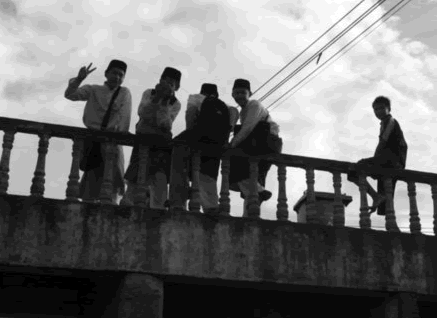
WHERE’S THE LOVING FEELING?
Can we coexist as one when irreversible damages have been done? Your guess is as good as mine. We’ve lost that loving feeling….
Troubled Times
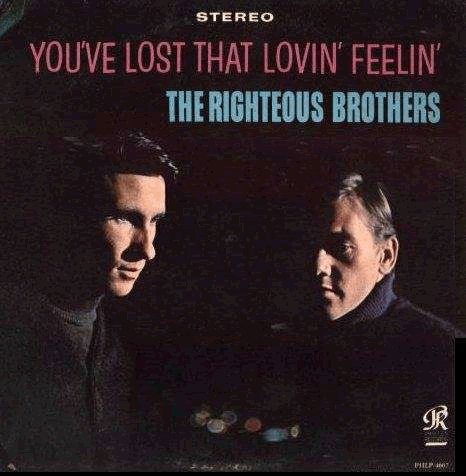 Those who grew up in the 60s would certainly recall this 1965 hit song, You’ve Lost That Loving Feeling by the Righteous Brothers. It was the number one song on the hit charts in the West. The song did fairly well in Malaysia, although it was not during the best of times. The country was being troubled by communist insurgents and a hostile neighbour bent on crushing the nation and its people. The message in the song has much relevance with the malady that is afflicting the nation today.
Although raised in a kampong I grew up in a town and was exposed to the bright lights at the tender age of five. Parit Buntar in the 50s and 60s was simply an insignificant provincial town with basic amenities, at best. Times were bad as the economy had nose dived due to falling rubber prices. There was not much development. The only buildings that were constructed were a row of shophouses and a 30-foot tall clock tower, a gift from a former hometown boy who made it big in Kuala Lumpur. The clock tower, built on a tiny roundabout at the entrance to the town, is still standing today but minus its grandeur. Back then it was the town’s only landmark
Kampong Roots
In spite of my urban upbringing I did not completely abandon my kampong roots. My brother and I would join our Malay brethren on weekends and during school holidays. Fishing was a form of escapism for me. The many ponds and streams that dotted the landscape were filled with ikan keli, puyu and haruan. I would use my grandmother’s priced fishing rod to fish. Hers was a seasoned bamboo pole with a hook and line on one end. In spite of its simplicity the rod worked wonders with fish, especially ikan puyu. For baits there was a plentiful supply of grasshoppers available in the idle padi fields behind our house. Catching grasshoppers requires a certain amount of talent which I acquired after watching the old lady deftly grabbing the insects with her bare hands.
The month of Ramadan was something we kids looked forward to in the kampong. The village’s madarasah would be a hive of activities. We would gather at the prayer house for breaking-of-fast and the tarawih prayers that followed. Moreh (mass-cooked food) would be served to the congregation after prayers. Some of us would remain behind taking turns to beat the giant cowhide-covered drum to warn villagers the time for sahor.
Hari Raya Puasa
Hari Raya Puasa was a time for celebration. Our house would be opened to all – relatives, neighbours and friends alike. I would invite my Chinese and Indian schoolmates over for makan and kueh raya. We welcomed them with open arms. And they would return the favour when their own festivities come around. We considered those from the Christian, Buddhist, Toaist, Sikh and Hindu faiths as friends. Entering, eating and spending the night in their houses were never a problem. There was no distinction separating one race from another and one religion from the other. The issue of halal and tak halal never cropped up. Churches, temples and mosques co-existed harmoniously in the nighbourhood.
Yes, we had our differences but they seldom degenerated into a brawl. Yes, we used our fists to settle scores but we would patch up in matter of moments. Yes, we called names and made gestures but they were in jest rather than in zest. We were Malaysians in the purest form. We breathed the same air and drank the same water.
Why was this possible? May be it was the way we were brought up. May be it was the school we went to. May be it was destined to be such. The colour of our skins and the faith we practised were irrelevant. We were brothers and sisters and like brothers and sisters we played, laughed, fought and made up all at the same time.
Adopting Islamic Values
Then came the Iranian Revolution of 1979. From then onwards things began to assume a different dimension. Suddenly, menerap nilai-nilai Islam (adopting Islamic values) became the vogue. Nowhere was this most eagerly pursued than in the armed forces. Beer, liquors and intoxicating drinks once prevalent in messes were removed. Warriors’ Day became a tame affair. No more parades at cenotaphs (except at the National Monument). No more one-minute silence in deference to the dearly departed. No more eulogies to honour those who made the ultimate sacrifices. And, worse, no more partying and merry-making. Soon all these became memories to jolt our conscience.
Haram becomes the buzz word and is bandied about with halal and tak halal. Shaking hands with women not your muhrim (relation) is taboo. Showing of affection at public places is disallowed. Entertaining your non-Muslim friends is considered improper. Sales of beer in Muslim dominated areas becomes an issue. A cow head is being used as an instrument of contempt. Open houses have turned into spurious state-sponsored functions without definitive reasons other than to splurge. Morale policing takes centre stage. And a single mother awaits caning for consuming beer. The charade has reached such levels of idiocy that it makes a mockery of our very own existence. This happens when religion and politics interface and become one. Civility takes a beating.
Irreversible Damages
Today Najib is trying hard to relive the past by imploring the rakyat to co-exist as one. But will 1Malaysia ever thrive when irreversible damages have been done? Your guess is as good as mine.
We definitely have lost that loving feeling. What a tragedy.